

Water, Stone, Silence of Italian Lakes
Northern Italy’s lakes and mountains offer something increasingly rare: luxury without ostentation, sophistication without pretension, nature without commodification.

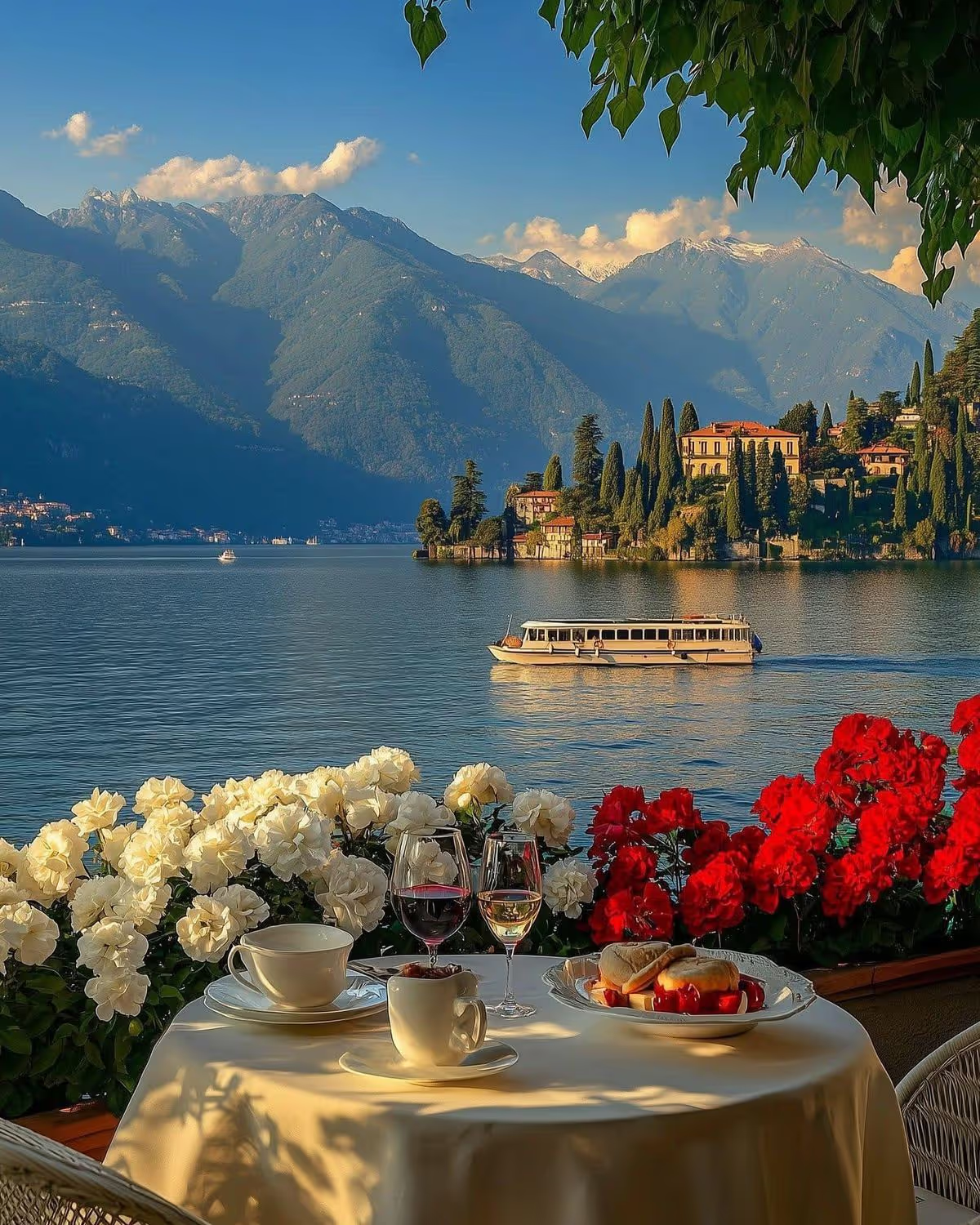
Italy’s lakes and mountains as refuge
Northern Italy’s lake country runs at a lower volume.
This is where Italy becomes Switzerland’s sophisticated cousin still devoted to pleasure, but with the sound turned down. Como, Maggiore and Orta have drawn the wealthy and the weary since Roman times, offering an escape from civilisation’s obligations without giving up its comforts.
What follows isn’t a tour. It’s a way in.
Not through crowds and coach stops, but through the kind of access that comes from long relationships: private villas that don’t advertise, family-run places that still feel like homes, and mountain traditions that haven’t been repackaged for applause.
This is refuge disguised as landscape.
Lake Como: the sophistication engine
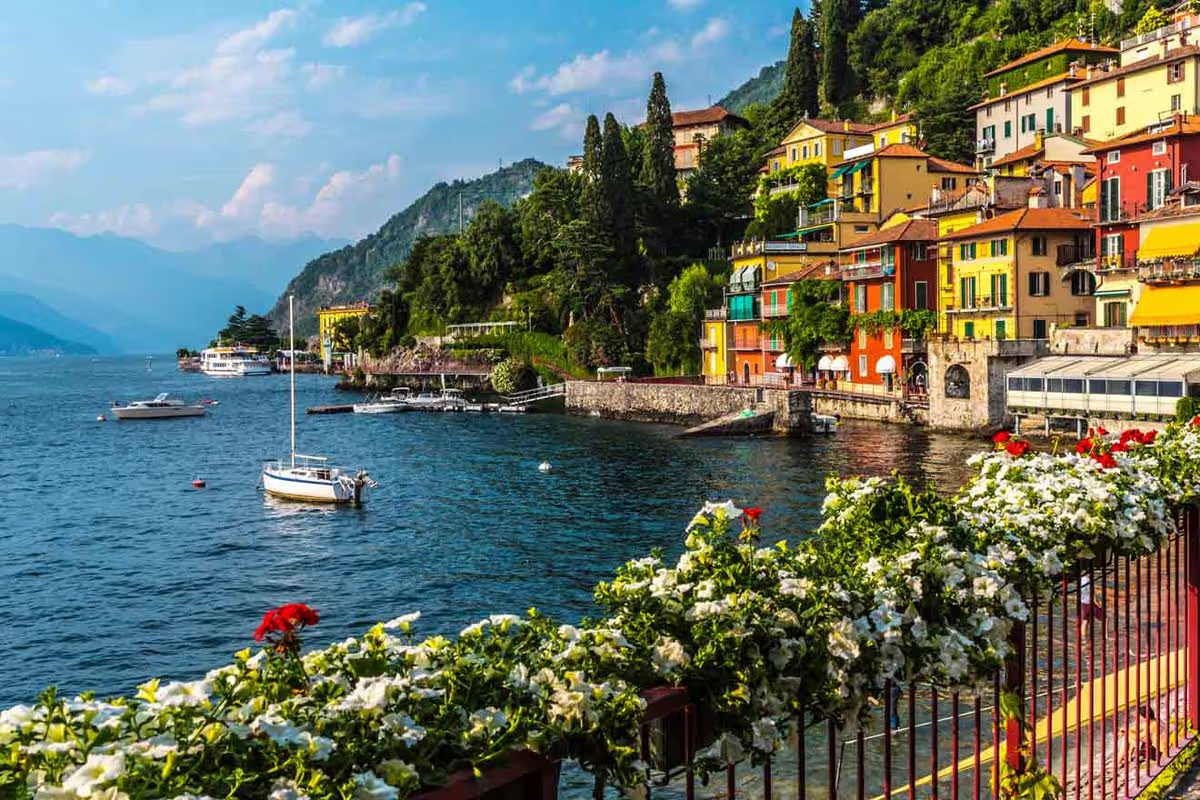
Como has always attracted a certain type: writers seeking isolation, artists needing a new angle of light, industrialists wanting to step away from industry.
The lake’s appeal isn’t just beauty. It’s the feeling of being close to civilisation and far from it at the same time.
Your approach matters here. Arrive by private boat from Como town to Bellagio, watching the Alps reveal themselves as the lake widens. Not transportation — transition.
At Villa Serbelloni, we arrange a private garden walk with the estate’s head gardener — a botanist who can explain which plants were brought in by 19th-century explorers, which are native to these slopes, and how microclimates allow Mediterranean species to thrive at Alpine altitude. These aren’t just gardens. They’re 200-year experiments in acclimatisation.
From Bellagio, take a 1950s Riva to Villa del Balbianello with an architectural historian who knows Lake Como’s villas like a family album. You’ll see how that impossibly romantic promontory was engineered — thousands of tons of rock moved so the gardens could appear to float above the water. It was extreme by the standards of the time. It still stops you.
Evening is at Il Gatto Nero in Cernobbio, a family restaurant that never chased fame but collected it anyway. The grandmother opened it in 1921. The techniques haven’t modernised because they don’t need to: whole perch grilled with sage, pike-perch baked in cartoccio (in paper), lavarello (lake whitefish) so fresh it was swimming that morning.
You’ll stay at Passalacqua, an 18th-century residence that feels less like a hotel and more like a sophisticated friend’s home — the kind where breakfast turns into late morning without anyone checking the time.
The Dolomites: geology as theology
The Dolomites aren’t the Alps. They’re weirder. More theatrical.
These peaks were coral reefs when this region was underwater, and their limestone shifts colour as the sun moves — pink to purple to a burning orange locals call enrosadira (when the mountains blush). It can look supernatural. It isn’t. It’s just light, doing what it does.
Begin with a via ferrata (an “iron path” of fixed cables and ladders) with a certified guide who has been on these routes since childhood. Many were reinforced during World War I, when soldiers fought in these mountains — a brutal, improbable battleground.
After the climb, go to a malga (an alpine dairy farm) where cheesemakers spend the summer producing formaggio di malga (mountain cheese) using methods that haven’t changed much for centuries. You’ll taste cheese made that morning from milk collected at dawn, with local speck and bread baked in a wood oven.
In parts of the Dolomites, people speak Ladin (a Rhaeto-Romance language spoken by a small community). They’ll tell you, plainly, that these traditions aren’t maintained for tourists. This is simply how life is organised here.
By evening, you’re dining at St. Hubertus — a mountain restaurant reached by cable car — where the cooking is contemporary but rooted in place: foraged alpine ingredients, mountain herbs, a sense of terroir without theatre.
You’ll stay at Forestis, a contemporary retreat where floor-to-ceiling windows frame the peaks and heated pools are fed by mountain springs. The luxury here is quiet: sleep, air, space.
Lake Maggiore: the botanical laboratory
Maggiore lacks Como’s celebrity and Garda’s mass infrastructure, which is exactly its appeal.
The Borromean Islands float in the lake like elaborate garden follies — each one a complete aesthetic statement.
We arrange early-morning access to Isola Bella before the public boats arrive. With a botanist guide, the garden becomes more than a photo: microclimates, citrus trees surviving at Alpine latitude, 17th-century hydraulics irrigating terraced slopes, engineering that keeps the whole baroque complex from sinking into the lake.
From there, take a private boat to Villa Taranto in Verbania — one of Europe’s great botanical collections. The Scottish captain who created it spent decades importing species from across the world. Touring with a head gardener changes what you notice: experiments that worked (dahlias blooming in November) and the ones that failed spectacularly (eucalyptus that dies every winter, despite optimism).
Evening is best kept simple.
On Isola Superiore, the only Borromean island with permanent residents, eat at a small family-run place where the food is based on what arrived that morning. You pay what seems fair. The unspoken agreement is that everyone behaves honourably. It’s Italian hospitality at its most fundamental.

Lake Orta: permission to do nothing
Orta is the lake everyone skips, which is why it stays perfect.
No major towns. No cruise ships. Just medieval Orta San Giulio and Isola San Giulio, home to a monastery that has been here, in one form or another, since the early centuries of Christianity.
Your days are deliberately unstructured.
Row a wooden boat to the island. Walk the single path around it. The monastery keeps silence, and the circuit is punctuated by phrases designed to slow the mind. It’s the kind of quiet that makes you aware of your own thoughts.
If you want a little structure, climb to Sacro Monte di Orta (a UNESCO site): 20 chapels winding up the hillside, baroque frescoes depicting the life of St Francis. Or don’t. The point of Orta is having permission to do nothing — to sit lakeside watching the light change, to read the book you’ve been carrying for months, to be present without agenda.
Dinner is at Villa Crespi, a Moorish fantasy that somehow works on an Italian lake. Chef Antonino Cannavacciuolo cooks technically Campanian food adapted to Piedmont ingredients — family recipes reimagined with local fish, Bettelmatt cheese from alpine dairies, hazelnuts from the Langhe. It’s ambitious cooking that encourages lingering.
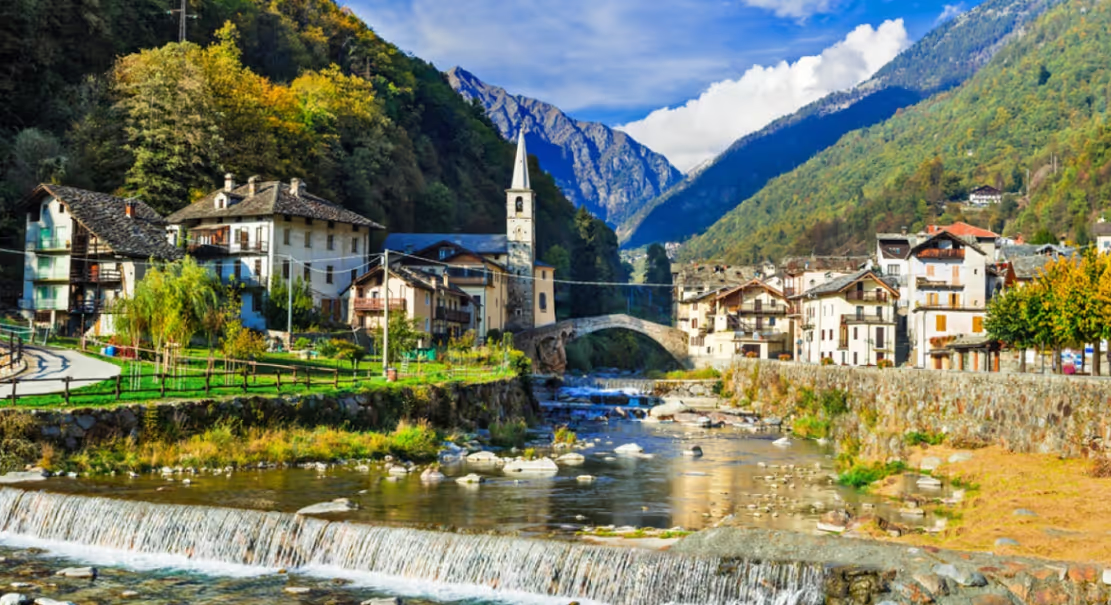
Val d’Aosta: mountain extremes
Italy’s smallest region sits between Switzerland and France and feels like a cultural borderland.
People speak Franco-Provençal, eat fondue as naturally as pasta, and ski terrain that can feel more serious than the Dolomites.
Visit Europe’s highest vineyards (around 1,200 metres), where Prié Blanc grapes produce whites with a clean acidity that cuts through the region’s rich food. The work is still manual because it has to be. Every bottle is earned.
Then go higher, to a working rifugio (mountain hut) at around 2,800 metres, reached by cable car and a short hike. Lunch here is often built from preserved foods — cured meats, aged cheeses, dried mushrooms — because fresh provisions are not guaranteed. And yet it can be some of the best food you’ll eat in Italy.
If you ski, do it properly: ski mountaineering with an IFMGA guide (International Federation of Mountain Guides Association) who knows which lines are safe and which are not. Ascend on climbing skins. Descend untracked couloirs. The reward is solitude. The penalty for error is real.
By evening, soak in the thermal springs at Pré-Saint-Didier, where Romans built bathhouses for exactly this reason.
Why this geography matters
Northern Italy’s lakes and mountains offer something increasingly rare: luxury without ostentation, sophistication without pretension, nature without commodification.
The best experiences here aren’t performed for you. They happen around you.
A morning when the lake is glass. An evening on a villa terrace that stretches longer than planned. A conversation with someone who has lived on this slope for five generations. A day with no ambition beyond walking, eating, and sleeping well.
You don’t leave with a list of highlights. You leave with a reset.
For customised lake and mountain itineraries:
manish@unhotel.in
.avif)
.avif)
Subscribe to stay inspired.
Stories, ideas, and slow journeys - from hidden villages to distant valleys, straight to your inbox.
.avif)