

Stone Sentinels
Svaneti is Georgia’s high mountain heart, where medieval stone towers rise from alpine valleys and daily life continues much as it has for centuries, shaped by isolation, resilience, and a deep sense of place.

.avif)
Svaneti’s medieval towers, where families still guard against the ghosts of clan warfare
The Caucasus Mountains (Georgia’s high range) keep Svaneti’s secrets in stone.
Four-storey defensive towers rise from alpine valleys like frozen sentinels, their narrow windows still watching for enemies who stopped coming centuries ago.
These aren’t ruins preserved behind ropes.
They’re family fortresses, places where people have lived, slept, stored grain, and kept lineage intact since a time when disputes were settled with blades, not paperwork.
Walk through Mestia (Svaneti’s main town) or Ushguli (high-altitude village cluster), and you’re moving through architecture frozen mid-feud.
Medieval clan warfare shaped these valleys physically. Every tower carries the memory of blood feuds, defensive design as survival, and an isolation so complete that Mongol invasions, Ottoman expansion, and Russian conquest all broke against Svaneti’s peaks like waves against cliffs.
UNESCO recognised this landscape in 1996, listing Upper Svaneti’s tower-house communities as World Heritage Sites.
But recognition raises a harder question.
How do you preserve living architecture?
What happens when family fortresses become tourist attractions?
Who owns a tower, the descendants who still maintain it, or the state that now protects it?
The answers matter because Svaneti’s towers are more than architectural curiosities.
They are physical records of how mountain communities survived, when isolation was protection, when families built upward because danger could come from any direction, and when stone walls had to be thick enough to outlast a siege.
To understand these towers, you have to climb into them.
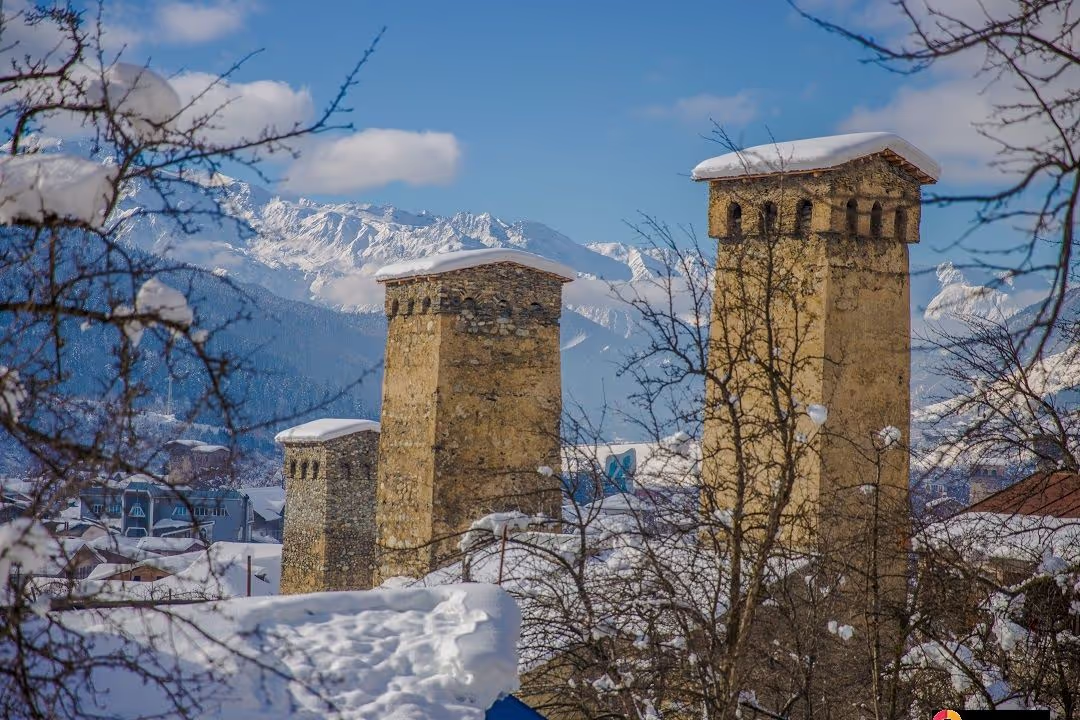
Medieval survival architecture: why towers?
Svaneti’s defensive towers weren’t aesthetic choices.
They were responses to specific threats, blood feuds between clans, raids from neighbouring valleys, avalanches, fires.
When conflict arrived, and in medieval Svaneti it arrived often, families retreated into stone.
A typical tower rises around 20–25 metres across four or five storeys.
Ground floor: livestock and grain.
Upper floors: living quarters, weapons, observation.
Top floor: machicolations (stone-drop openings), narrow defensive windows, lookout positions with sight lines across the valley.
Construction used local slate and limestone. Some towers were stacked dry (without mortar). Others were cemented with lime.
Walls at the base often exceed a metre in thickness, tapering as they rise.
The engineering is remarkable.
These towers have withstood earthquakes, avalanches, and centuries of Caucasus winters.
But their real genius wasn’t only defensive.
It was social.
A family tower was also a declaration.
This clan controls this patch of valley.
Height signalled influence. The tallest towers belonged to the most powerful families.
Blood feuds could last generations.
A killing demanded retaliation. Retaliation demanded another.
Families spent long periods fortified, venturing out only when necessary, tending fields under the shadow of threat.
Grain stored below meant a household could withstand a siege.
Water sources within a tower complex meant enemies couldn’t simply cut supply.
The defensive era ended centuries ago.
Russian imperial control reached Svaneti in the 19th century, imposing peace through force. Feuds became illegal.
The towers lost their military purpose.
But families didn’t abandon them.
The architecture that once protected against clan enemies still protects against avalanches, provides cool storage, and holds family archives.
What remains is stone testimony to how communities survive when geography isolates them and only family can be trusted.
.avif)
Mestia and Ushguli: tower clusters as living museums
Mestia holds dozens of medieval towers scattered among newer buildings.
Walk through town and you see an architectural palimpsest, 13th-century defensive towers rising beside Soviet-era concrete, traditional Svan houses (stone-and-wood homes) next to new guesthouses built for tourism.
Some towers are maintained as museums.
The Margiani House Museum (historic tower home) is one example, showing traditional Svan life, weapons, tools, textiles, religious icons.
But the most compelling towers aren’t museums.
They’re still family-owned, still used, still part of winter storage and family memory for people who’ve held them for centuries.
Ushguli sits higher, around 2,100 metres above sea level, often described as one of Europe’s highest continuously inhabited settlements.
It’s a cluster of four communities, Zhibiani (Ushguli hamlet), Chvibiani (Ushguli hamlet), Chazhashi (tower village core), Murkmeli (Ushguli hamlet), holding more than 70 medieval towers.
UNESCO designated Upper Svaneti largely because Ushguli shows how medieval settlement patterns survived into modern life.
Walking here feels like time travel.
Towers dominate the skyline. Narrow stone lanes wind between fortified houses.
Cattle graze below Mount Shkhara (Georgia’s highest peak).
The remoteness is real.
Until recently, Ushguli was snowbound for months, accessible only by foot or horseback. Even now, the road from Mestia is rough.
That isolation preserved what modernisation erased elsewhere.
Some families offer homestays.
You sleep in rooms shaped by defensive architecture, climb steep ladders between floors, and wake to alpine light filtering through narrow windows.
It isn't a luxury.
Comfort is basic. Heating is limited. Wi‑Fi is unreliable.
But staying with families gives you something museums can’t.
A sense of how architecture shapes daily life, and how a medieval building is adapted, quietly, to the present.
Access to private towers depends on relationships.
Some families welcome visitors for a small fee. Others keep towers closed, maintained as heritage rather than attraction.
The key is to approach towers as living architecture, not ruins.
.avif)
Stone masonry as cultural transmission
Building a Svan tower required knowledge accumulated over generations.
Stone selection. Wall construction. Drainage. Resistance to earthquakes.
This knowledge wasn’t written down.
It passed from master stonemasons to apprentices through demonstration and repetition.
Traditional construction used slate and limestone quarried nearby.
Stones were shaped by hand and fitted with minimal gaps, sometimes secured with wooden pegs rather than mortar.
The result was a structure with a kind of flexibility, walls that could move slightly during seismic activity instead of cracking.
Modern restoration is complicated.
UNESCO status demands historical authenticity, but many towers face structural problems, water damage, foundation settling, stone erosion.
Finding craftsmen who understand traditional methods is difficult.
Young Svans often leave for Tbilisi (Georgia’s capital) or abroad, looking for work beyond mountain agriculture and tower maintenance.
Some projects now employ remaining master stonemasons to train younger workers.
The work is slow.
A single tower restoration can take years, sourcing matching stone, rebuilding with original techniques, repairing slate roofs tile by tile.
It costs more than modern construction.
But preserving towers without destroying their integrity demands traditional approaches.
The challenge is also economic.
Maintaining a medieval tower brings little direct return.
Families face ongoing costs, roof repairs, stabilisation, winter damage.
Tourism helps through homestays and entry fees, but most tower owners are not wealthy.
They maintain these buildings through obligation as much as profit.
Government support exists, but it’s limited.
Whether it will be enough to maintain the hundreds of towers across Upper Svaneti remains uncertain.
.avif)
Families living in fortresses
In Mestia, some families still use their towers much as their ancestors did.
Ground floors store hay and tools.
Upper floors hold living quarters and sleeping spaces.
The top level remains a lookout, now for weather and livestock rather than raiders.
Daily life adapts medieval architecture to modern needs.
Stone walls keep interiors cool in summer.
In winter, heating still relies on wood fires.
Moving between floors means steep ladders or narrow stairs.
Windows admit limited light, so interiors stay dim even with electricity.
Many families now live mainly in adjacent modern houses, using towers for storage, ceremonies, and family archives.
Icons, textiles, tools, objects that carry memory.
Ownership usually follows family lines.
That can create tension.
Restoration costs fall on the relatives who stayed.
Siblings who left may still expect a share.
Tourism revenue rarely covers maintenance.
Some families open towers to overnight guests.
The experience is simple, shared facilities, home-cooked meals, conversation that moves at the speed of the mountains.
But it offers cultural exchange that hotels can’t.
You hear tower histories from the people who inherited them.
You learn how a roof is repaired.
You understand why a family keeps a structure standing when abandoning it would be easier.
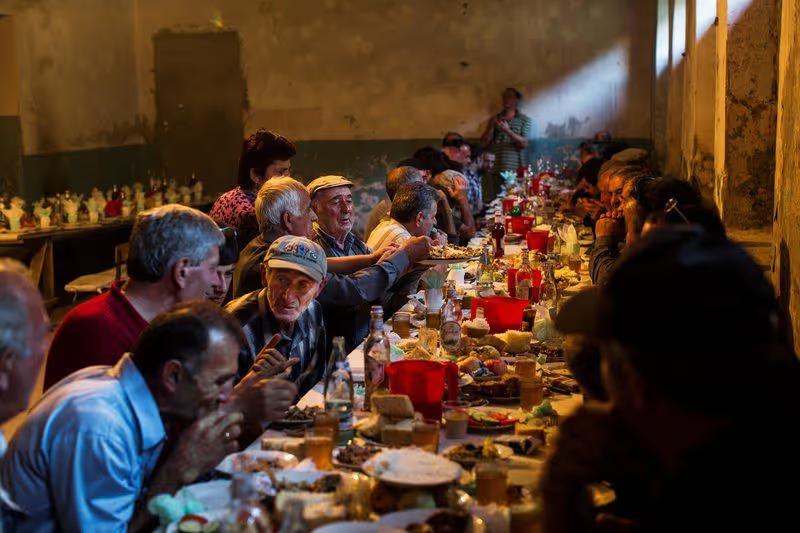
Why stone sentinels matter
Svaneti’s towers are architecture as cultural survival.
Lineage made visible.
Family identity expressed in stone.
Proof that these clans held these valleys while empires rose and fell beyond the peaks.
For travellers, the towers offer entry into a mountain culture that much of modern tourism has flattened elsewhere.
Climbing narrow stairs between medieval floors, learning how stonework is maintained, staying with families who live inside their own history, these aren’t staged experiences.
They are living heritage.
The tension is unavoidable.
Too many visitors, and towers become hotels. Hospitality becomes performance.
Too few, and the economics collapse. Families abandon heritage buildings. Traditional knowledge dies with the last master masons.
So the only responsible way to visit is with awareness.
Ask permission before photographing private towers.
Accept when access is declined.
Remember these are homes first, historical sites second.
The towers still stand because families chose to maintain them across centuries.
That continuity is Svaneti’s real treasure.
Not the towers alone.
The commitment that keeps them inhabited.
This is Georgia at its most stubbornly authentic.
Mountain families guarding stone heritage against time, weather, and the slow erosion of tradition.
The sentinels endure.
The question is whether the next generation inherits that guardianship, or lets the towers finally fall silent.
For access to Svaneti’s family towers and authentic mountain experiences:
manish@unhotel.in
.avif)
Subscribe to stay inspired.
Stories, ideas, and slow journeys - from hidden villages to distant valleys, straight to your inbox.
.avif)