

Tunnels, Trauma, Transformation
A reflective look at the Vietnam War that traces its lasting impact on landscapes, cities, and everyday life, exploring how history is remembered, lived with, and quietly woven into modern Vietnam.

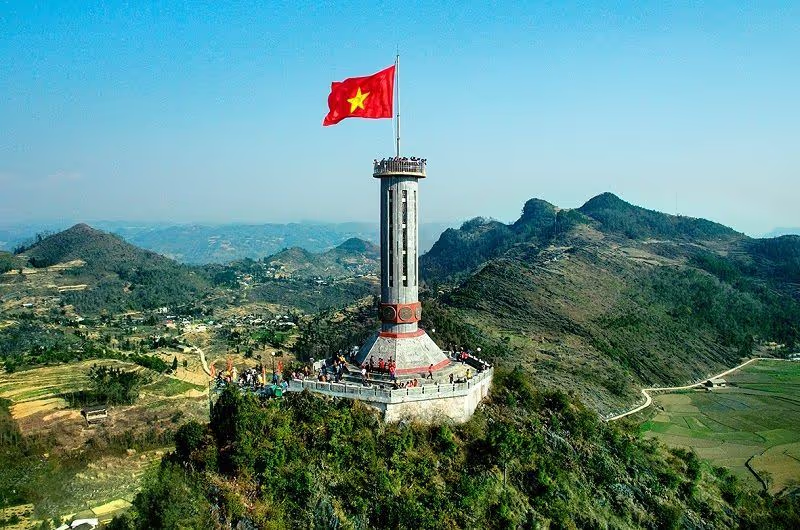
How Vietnam lives with the war that officially ended in 1975
The American War, that is what many Vietnamese call it, officially ended on 30 April 1975, when North Vietnamese tanks broke through the gates of Saigon’s Independence Palace.
But wars do not end when fighting stops.
They persist in unexploded ordnance (undetonated bombs and mines) that still kills farmers. In Agent Orange (toxic defoliant chemical) that shows up in bodies two and three generations later. In economic structures shaped by decades of conflict. In a collective memory that cannot be legislated away.
Vietnam has moved forward economically, diplomatically, and culturally. Ho Chi Minh City, still called Saigon by many residents, is a commercial powerhouse. The United States and Vietnam have normal diplomatic relations. American tourists arrive in large numbers.
And still, the war remains present.
In landscapes scarred by bombing. In museums that refuse to soften atrocity. In tunnel networks that have become public sites. In the slow, dangerous work of clearing munitions that continue to maim and kill.
What follows is an engagement with recent history that shaped modern Vietnam, and with the question that sits underneath it.
How does a society live with trauma when the calendar insists it is over?
This is history that has not finished happening.
Củ Chi: engineering as survival
The Củ Chi tunnel network near Ho Chi Minh City stretches for hundreds of kilometres underground.
Living spaces. Hospitals. Command centres. Weapon workshops.
All carved beneath and around American military positions.
The engineering is remarkable.
The survival it represented is more so.
Tunnels were dug by hand with basic tools. Soil was removed gradually to avoid detection. Ventilation was designed to hide smoke. Water traps were built to block gas. Blast doors were added for protection.
People lived underground for months, sometimes years.
Fighting, sleeping, eating, treating the wounded, manufacturing weapons, in spaces barely large enough to turn around.
The sections open today are widened for visitors. The original tunnels were smaller, built for Vietnamese bodies, and intentionally cramped to prevent pursuit.
Even widened, they are claustrophobic.
Dark. Hot. Airless.
Twenty minutes below ground gives you a visceral sense of what months might have done to the mind.
Củ Chi also carries the awkwardness of any war site that becomes public.
There are remnants, tanks, craters, weapons, and there is a narrative that can feel blunt, even propagandistic.
To understand Vietnam’s perspective, you have to accept that their story of the war will not be told in American language.
Wars contain multiple truths.
And every country edits its own pain.
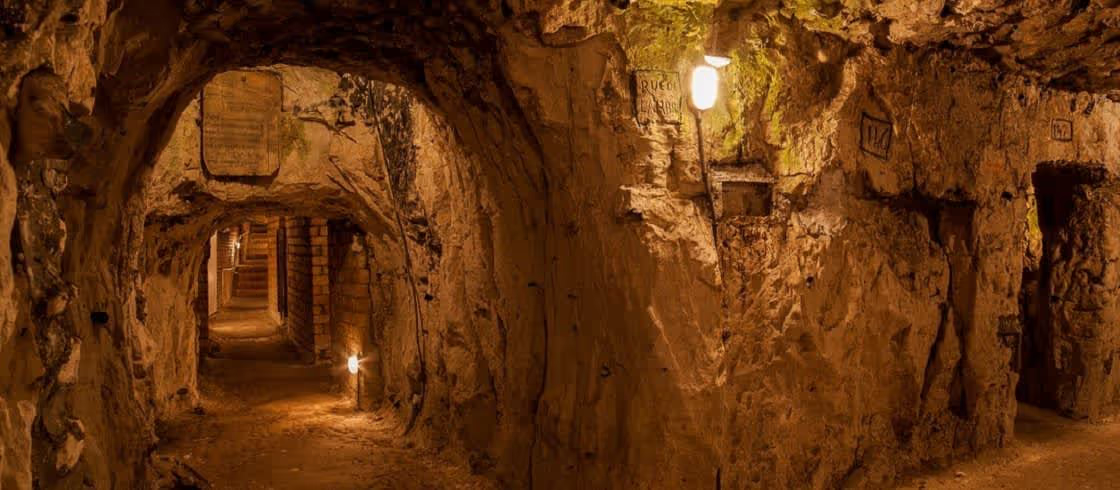
The DMZ: where division became landscape
The Demilitarised Zone (border strip dividing Vietnam) along the 17th parallel divided Vietnam from 1954 to 1975.
The name was ironic.
It became one of the most heavily militarised regions on earth.
Firebases. Artillery. Constant bombing.
The landscape still carries it.
At Khe Sanh, the site of a 77-day siege in 1968, you can still see the bones of a base, rusted aircraft, collapsed bunkers, runways being swallowed by grass.
At Vĩnh Mốc, tunnels sheltered entire villages.
This was not a military network.
It was a civilian refuge.
Families lived underground for years. Children were born there. Lessons continued in tunnel classrooms. Life persisted beneath the violence.
The DMZ also reveals the war’s afterlife in the ground itself.
Bomb craters are still visible decades later. Forests regrown, but ecosystems altered. Rivers and soil contaminated by chemical defoliants.
And the danger that remains.
Unexploded ordnance (undetonated bombs and mines) buried in fields. Cluster munitions (small bomblets in clusters) scattered across land that looks ordinary until it is not.
A museum that refuses comfort
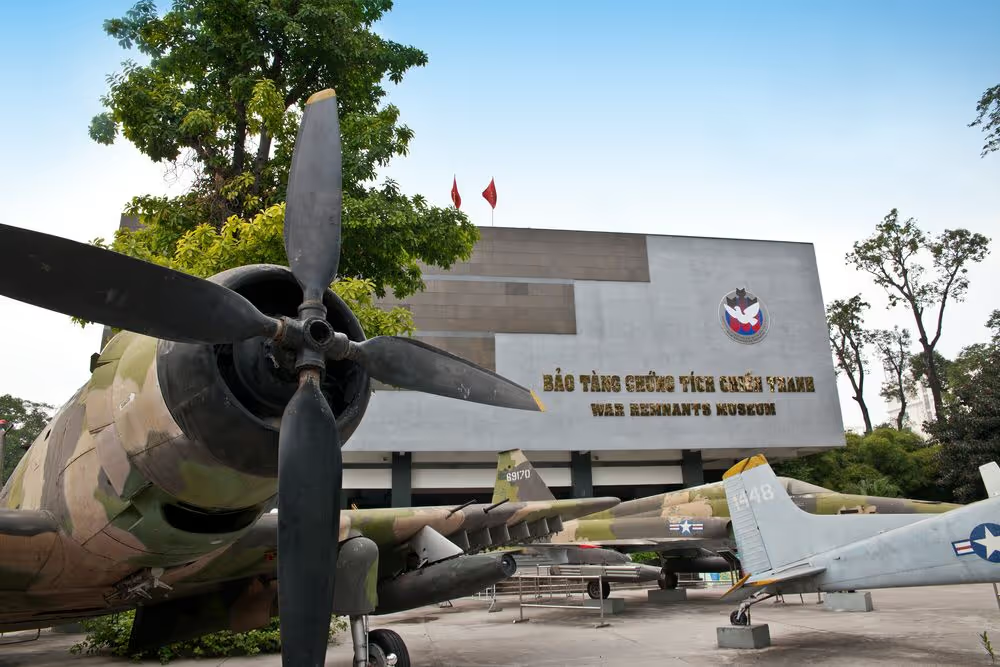
Ho Chi Minh City’s War Remnants Museum does not sanitise.
Photographs show civilian casualties. Napalm (jellied fire weapon) victims. Executions. The exhibits present the war from a Vietnamese perspective, without the American counter-narrative many Western visitors expect.
It can be difficult.
Particularly for Americans.
But discomfort is part of the point.
The museum is not trying to be neutral.
It is trying to remember.
The Agent Orange (toxic defoliant chemical) section is especially devastating.
Images of children born with severe disabilities decades after spraying. Scientific documentation of dioxin (long-lasting toxic pollutant) persistence. Ongoing treatment for effects that do not stop with the generation that fought.
Agent Orange was not only a wartime weapon.
It is a continuing tragedy.
There are also photographs by international journalists, including those who died covering the war. These images can act as a bridge, not because they are objective, but because they show atrocity witnessed by outsiders too.
This is not academic history.
It is a confrontation.
From war economy to Asian tiger
Vietnam’s post-war economic trajectory is one of the most striking transformations in modern Asia.
Reunification in 1975 left the country devastated.
Infrastructure destroyed. Agriculture damaged by chemicals and bombing. An economy structured around wartime production.
The years that followed brought crisis, failed collectivisation, and international isolation.
Then came Đổi Mới (market reform programme) in 1986, reforms that opened the economy while maintaining single-party political control.
The results were dramatic.
Vietnam moved from food importer to one of the world’s largest rice exporters. Foreign investment flowed in. Manufacturing expanded. Poverty fell sharply.
Ho Chi Minh City embodies the change.
The city Americans called Saigon, renamed after the communist leader, is now a Southeast Asian commercial hub.
Skyscrapers. International brands. Luxury hotels. Traffic that never seems to stop. Construction everywhere.
There is an irony here that is hard to miss.
A communist victory, followed by a market economy.
American companies operating profitably in a country America once tried to destroy.
Economic success, of course, is not a clean ending.
It brings inequality, environmental damage, urban–rural divides, corruption.
Development solves some problems and creates others.
Reconciliation: incomplete, and ongoing
Vietnam and the United States established diplomatic relations in 1995, twenty years after the war ended.
Normalisation enabled remarkable developments.
Trade. Investment. Students studying abroad. Tourists moving freely. Veterans returning to places where they fought, trying to make sense of their own memories.
Some meet former enemies.
Some build friendships.
Some fund schools.
Some support bomb clearance.
In small ways, they try to repair what they can.
And still, reconciliation remains incomplete.
There has been no full apology. Compensation for Vietnamese Agent Orange victims is minimal compared to support for American veterans. Ordnance clearance is slow and underfunded.
Narratives do not reconcile easily.
Vietnam’s official story frames the war as patriotic resistance against foreign aggression.
Many Americans frame it as failed intervention, tragic mistake, government deception, or a necessary stand against communism.
Progress often happens through practical cooperation rather than shared interpretation.
Trade agreements. Security concerns. Joint work on missing soldiers.
The past is not agreed upon.
But the future is negotiated anyway.
.avif)
The war’s afterlife: ordnance and Agent Orange
An estimated hundreds of thousands of tonnes of unexploded ordnance (undetonated bombs and mines) remain in Vietnamese soil.
Bombs. Shells. Landmines. Cluster munitions (small bomblets in clusters).
They continue to kill and injure people decades later. They contaminate land. They prevent farming. They turn ordinary work into risk.
Clearance is slow, expensive, and dangerous.
Metal detectors. Careful excavation. Transport to demolition sites. Controlled detonations.
The scale is staggering.
At current rates, full clearance would take generations.
Meanwhile, farmers hit bombs while ploughing. Children pick up cluster munitions that look like toys. Scrap collectors die extracting metal.
Agent Orange persists too.
Dioxin contamination remains in soil and water near former bases and heavily sprayed areas. Cancers, immune disorders, birth defects.
Children born long after American withdrawal still carry the cost.
This is the part of the war that does not fit neatly into a museum.
Because it is still happening.
Why engaging with this history matters
It is possible to visit Vietnam and never touch this story.
To eat well. To take photographs. To move through beautiful landscapes.
But if you avoid recent history entirely, you miss what shaped modern Vietnamese society.
The war affected demographics, infrastructure, education, healthcare, politics, international relations, and the country’s inner weather.
Engagement also has to be done carefully.
War sites can become theme parks. Tunnel crawling can become a photo-op. Museums can become a box to tick.
Serious engagement means preparation.
It means allowing discomfort.
It means recognising the limits of your understanding.
And it means holding two truths at once.
Western narratives often centre the war as an American tragedy.
Vietnamese narratives centre it as an independence struggle against foreign domination.
Both contain pain.
Both contain propaganda.
Both contain human lives that were not abstractions.
You leave with a quieter understanding.
That wars do not end cleanly.
That reconciliation is a practice, not an achievement.
That economic success can coexist with unresolved trauma.
And that the war Americans call the Vietnam War and Vietnamese call the American War describes the same events, but means different things depending on who is speaking.
For thoughtfully designed historical itineraries in Vietnam:
manish@unhotel.in
.avif)
.avif)
.avif)
Subscribe to stay inspired.
Stories, ideas, and slow journeys - from hidden villages to distant valleys, straight to your inbox.
.avif)