

Georgia – The Last Qvevri Masters: 8,000-Year Wine Revolution in Monastery Cellars
From ancient qvevri buried in earth to modern wine tables, this is the story of Georgia where wine is ancestry, not industry.

Introduction – The Wine Cellar Older than History
If you think your family recipe for dal has been around for generations, wait till you meet Georgia’s wine. We’re not talking a few centuries of cork and barrel. We’re talking 8,000 years, sealed not in dusty glass bottles but in giant clay vessels buried under monastery courtyards. This is wine that remembers the Bronze Age.
Wine as Heritage, Not Commerce
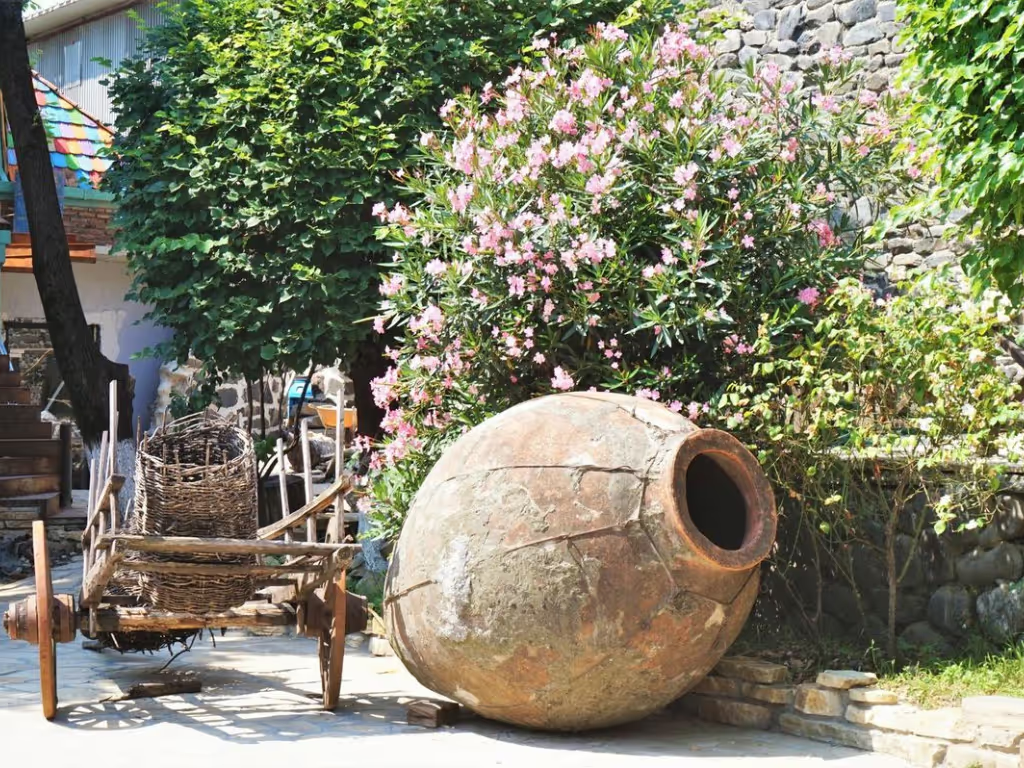
In Georgia, wine has never been just something you pour at dinner. It’s identity itself- pressed, fermented and guarded in earth. The heart of this story lies in the qvevri (pronounced kweh-vree): vast amphora-like pots shaped by hand, coated with beeswax inside, and buried underground to let nature and clay do their quiet work.
Unlike French châteaux or Napa estates where wine is sold with tasting notes and fancy labels, here it’s about continuity. Families keep qvevri wine in the same backyard where their great-grandparents did. Monks bless it before feasts, farmers drink it before heading to the fields, and every sip is a reminder that this is not a commodity- it’s communion.
UNESCO Recognition
So unique is this craft that in 2013, UNESCO stepped in and declared qvevri wine-making an element of the world’s “Intangible Cultural Heritage.” And it makes sense. This isn’t heritage you hang on a museum wall- it’s living, breathing practice. Villagers still sculpt the massive clay jars, fire them in wood-fuelled kilns, and lower them into the soil, where they stay for decades.
For UNESCO, this wasn’t about preserving a quaint rural curiosity. It was about safeguarding a philosophy: that wine, when made this way, carries more than flavour. It carries language, ritual, memory- the whole Georgian sense of self.
A Personal Invitation
For us travellers, this is not just another “wine region” to tick off. It’s a chance to step into a clay cellar and realise you’re not just tasting a drink, but a civilisation. The qvevri holds silence and song, faith and feast, work and worship- all at once.
And if you’re wondering what the fuss is about, think of it this way: anyone can open a bottle. But in Georgia, when you open a qvevri, you’re uncorking time itself.
.avif)
The Qvevri Tradition
If wine in France wears a tuxedo and in Italy struts in a linen shirt, then in Georgia it squats barefoot in the soil, humming folk songs to itself. The qvevri tradition doesn’t bother with glamour. It’s older than glamour. It’s wine at its most elemental: clay, grape, time.
A History Buried in the Soil
Archaeologists digging in Georgia’s river valleys have uncovered fragments of clay jars stained with ancient grape residue. Some date as far back as the 6th millennium BCE- which means Georgians were already fermenting wine when most of the world was still figuring out wheels and written alphabets.
What’s remarkable is the continuity. Across invasions, empires and religions, the qvevri remained a constant. Kings and peasants both drank from it; monasteries guarded its recipes like scripture. When UNESCO listed it as heritage, it wasn’t protecting a fragile remnant but acknowledging a practice still stubbornly alive in village backyards.
Imagine this: a line stretching unbroken from a Neolithic farmer burying his first clay jar to a modern winemaker in Kakheti lowering grapes into an earthen belly today. Few food traditions can boast that kind of uninterrupted lineage.
Symbolism: Clay, Earth, and Spirituality
The qvevri is not just a container- it’s a philosophy moulded in clay. Georgians believe that wine should be born of earth and return to earth. The shape itself, a kind of elongated oval, mirrors both the womb and the seed. In many ways, the qvevri is less a vessel and more a metaphor for life cycles: creation, nurturing, rebirth.
The clay connects wine to soil in a literal sense. Unlike wooden barrels that impose their own personality- oak, smoke, spice- the qvevri allows the grape to speak in its purest accent. The earth doesn’t disguise; it reveals. And in a culture where toasting (supra) is practically a spiritual act, wine is not an accessory but a sacred participant in prayer, memory, and poetry.
Monks have long argued that fermenting underground keeps the wine closer to God, shielded from vanity and pretension. You don’t display a qvevri in a tasting room. You bury it, guard it, and trust the earth to work its quiet alchemy.
Shaping the Vessels
Making a qvevri is itself a ritual. Potters work slowly, layer by layer, coiling clay walls up to heights that can exceed two or even three metres. Each one can take months to complete and must be fired in massive outdoor kilns, often fuelled with wood that imparts subtle mineral traces.
The inside is coated with beeswax- not for flavour but for protection, preventing seepage and allowing decades of use. Some families boast qvevris that have been in continuous service for generations, passed down like heirlooms.
It’s hard not to draw parallels with Indian matkas or surahis, those humble clay pots that keep water cool in scorching summers. Both honour the idea that clay and time transform the mundane into something elemental.
.avif)
The Underground Cellar
Once ready, the qvevri is sunk into the ground, leaving only its rim visible. Grapes- skins, seeds, sometimes stems- are pressed and poured inside. Fermentation begins not in the open air but in the cool silence of earth.
The underground setting maintains a steady temperature, crucial for slow, even fermentation. Over months, sometimes years, the wine matures, drawing subtle mineral whispers from the clay walls. The sediment settles naturally, and what emerges is a wine that is robust, golden, often slightly tannic- even whites carry the amber depth of skin contact.
Locals call this process churi, and the results are unlike anything you’ll taste from barrel-aged Chardonnay or Cabernet. This is wine with grip, with structure, with the kind of honesty that doesn’t flatter the tongue but engages it.
Ageing and Awakening
When the time comes, the lid is pried open, and the wine is drawn into pitchers for feasts and family gatherings. Some vintners now bottle it for global export, but the true experience is still communal: ladled straight from clay to glass, often accompanied by a table groaning with bread, cheese, and song.
What’s striking is how sustainable the method is. No steel, no chemicals, no industrial machinery- just earth, grape, wax, patience. In an age of over-engineered everything, qvevri wine feels radical in its simplicity.
A Living Heritage
The qvevri is not a relic locked behind glass; it is a heartbeat still audible in Georgian villages. Each vessel tells a story not only of taste but of resilience: how a tiny nation kept its identity intact through centuries of change by burying it, quite literally, in the soil.
For the traveller, stepping into a qvevri cellar is not about swirling and sniffing like in a Napa tasting room. It’s about realizing that you are drinking from the same tradition that once refreshed warriors, comforted poets, and accompanied monks in their chants.
In Georgia, wine is not an industry- it’s ancestry. And the qvevri is its clay-lined memory bank, still fermenting the past into the present.
Monasteries as Guardians
If the qvevri is the womb where Georgian wine is born, the monasteries are its guardians- keepers of both the clay and the creed. You’ll find, scattered across the valleys of Kakheti or perched on rugged hilltops, monasteries that have watched over vines longer than most empires have lasted. These are not just holy enclaves but living archives, where the spiritual and the sensual intertwine in ways that feel almost scandalously harmonious.
.avif)
The Church and the Vine
The Georgian Orthodox Church has long understood that wine is more than a drink- it is theology poured into a vessel. Since the fourth century, when St. Nino brought Christianity to the land, the cultivation of vines became inseparable from the Christian faith. Monks tilled the vineyards, not simply as labourers but as custodians of creation itself. Their cellars, carved into stone, housed vast qvevris buried underground, ensuring that both prayer and fermentation happened in silence and secrecy.
Step into one of these monasteries today- say, Alaverdi Monastery near Telavi- and you’ll feel history thrum in the air. The 6th-century walls are cool, the light diffused, and somewhere beneath your feet a qvevri the size of a buffalo is quietly doing its work. Here, the sacred and the everyday collapse into one another: a monk might finish chanting the Divine Liturgy and then descend into the marani (wine cellar) to check the fermentation cap.
Living Museums in Stone and Clay
These monastic wine cellars are not exhibits frozen in time; they are working museums, breathing with yeast and prayer. The walls bear soot from centuries of candlelight, and yet the qvevris are freshly sealed with beeswax, ready for another vintage. Unlike touristy wineries where tasting notes are rehearsed, here you learn that wine has its own pulse. Monks will sometimes let you lower a ladle into the vessel itself- a gesture that feels halfway between communion and initiation.
The clay itself is deeply symbolic: it comes from the earth, fashioned by hand, and returns to the earth as the wine matures underground. In this cycle, the monasteries see a metaphor for resurrection. What dies, ferments, and is reborn is not only grape juice but faith, memory, and community.
Supra: The Feast as Liturgy
But the monks do not stop at fermentation. Wine in Georgia culminates in the supra- the traditional feast where the table becomes an altar and the tamada (toastmaster) presides like a priest of conviviality. At monastic supras, the toasts are not idle chatter. The tamada begins with God and peace, then extends blessings to ancestors, guests, even absent loved ones. Each toast unfurls like a miniature sermon, and by the time the meal ends, you realise you’ve not just eaten and drunk- you’ve participated in a living theology.
It is a scene that can catch the Indian traveller off guard: a long wooden table, dishes of lobio (bean stew), churchkhela (nut-studded grape must), and mountains of bread, with monks raising clay bowls of amber wine. There’s a laughter that rings through centuries, a reminder that spirituality is not ascetic denial but a celebration of life’s abundance.
Why the Monasteries Matter Today
In an era where global wine is often about market share and branding, these monasteries remain defiantly out of sync. They do not bottle for supermarkets; they produce for the soul. Their cellars remind us that wine was never just a commodity but a covenant- between land and labour, between faith and festivity.
For travellers, visiting these sites is not about “wine-tasting” in the modern, antiseptic sense. It is about being drawn into a rhythm where clay, grape, and prayer are all parts of the same continuum. To sip a qvevri wine here is to taste something both ancient and immediate: the patience of monks, the stubbornness of clay, and the whisper of a vine that has seen kingdoms rise and fall.
.avif)
The Last Qvevri Masters
Every glass of Georgian wine owes its existence not only to the vine or the monk but also to an almost anonymous figure: the qvevri maker. Without the potter’s hands shaping clay into those colossal, womb-like vessels, the 8,000-year story of Georgian winemaking would grind to a halt. And yet, walk through villages in Kakheti or Imereti today, and you’ll find only a handful of such artisans left- grey-haired men working in smoky, cavernous workshops, their craft balanced precariously on the edge of extinction.
The Keepers of Clay
In the east, in Kakheti, master potters such as Zaza Kbilashvili are treated almost like folk heroes. His yard is littered with giant clay bellies half-buried in the earth, waiting to be fired. The scale is astonishing: some vessels rise taller than a man and can hold up to 3,500 litres of wine. The potter begins with local clay, kneaded until pliable, then coiled upward day by day. A single qvevri can take a month just to shape, followed by weeks of drying before it is sealed with beeswax inside and sunk into the soil.
In western Georgia’s Imereti region, the shapes are often smaller, rounder, adapted to different microclimates and fermentation traditions. But the principle is the same: clay, patience, and muscle memory passed down like a prayer. Unlike industrial winemaking equipment, there is no blueprint here, no standardised measurement. Every vessel bears the personal touch of its maker- the thickness of the lip, the curve of the belly, the subtle tilt in symmetry. A qvevri is less a container than a fingerprint in clay.
Workshops on the Brink
Visiting one of these workshops is like stepping into another century. The walls are blackened with smoke from ancient kilns. Clay dust swirls in the air, coating every tool and surface. There are no machines humming in the background, just the rhythmic slap of clay against palm, the slow layering of coils, the hiss of fire. It feels both elemental and precarious.
The challenges are enormous. The vessels are fragile before firing- one crack, one uneven drying, and weeks of work collapse into ruin. The kilns themselves are monstrous, needing days of continuous stoking to reach the right temperature. And when the finished qvevri finally emerges, it is too heavy to be moved easily; often neighbours are called to help roll it across planks and lower it into the ground.
This is labour that doesn’t fit into modern economies. Where stainless steel tanks can be factory-made in a matter of hours, a qvevri requires months of patient handwork. It is slow art in an impatient world.
The Vanishing Apprentices
Perhaps the most haunting aspect of this tradition is the silence of youth. Few young Georgians are stepping into the role of qvevri maker. The work is grueling, the income modest, and the prestige far less glamorous than a career in winemaking, tourism, or technology. Many potters’ sons and daughters move to Tbilisi or abroad, leaving the workshops echoing with the sound of only one pair of hands.
UNESCO may have inscribed qvevri winemaking as intangible cultural heritage in 2013, but heritage listings don’t automatically create apprentices. When you ask an old master who will take over after him, the answer is often a shrug, a sad smile, or a quiet “no one.” The vessels may last a century underground, but without potters, no new ones will be born.
.avif)
Why It Matters
Standing in these workshops, watching a potter’s clay-stained fingers coax a form out of mud, you realise that what’s at stake isn’t just the survival of a craft. It is the survival of a worldview- one where wine is not manufactured but gestated, where the vessel itself is part of the miracle. Lose the qvevri, and you lose not just Georgian wine as the world knows it, but also the invisible dialogue between earth, hand, and grape.
For the traveller, meeting these potters is a humbling encounter. They are not celebrities, they do not host polished tastings, and yet their fingerprints lie on every sip of amber wine you raise to your lips in Georgia. They are the unsung architects of an ancient culture, working in clay while the rest of the world speeds past in glass and steel.
The question that lingers is chillingly simple: what happens when the last qvevri master lays down his tools? Will the earth still yield its vessels, or will silence take the place of song in Georgia’s vineyards? For now, their kilns are still burning. But the fire is fragile.
The Wine Revolution
From village courtyards to Michelin wine lists
It’s almost funny how the world has come full circle. For decades, Georgia’s qvevri wines were dismissed as peasant brews- too rustic, too cloudy, too earthy for the polished palates of Paris or Napa. And now? The same cloudy, amber-hued wines are what sommeliers whisper about with reverence, what Michelin-starred restaurants proudly pour into fragile crystal glasses. What was once “old-fashioned” is suddenly the avant-garde.
Orange is the new red
The global rediscovery of so-called “orange wines”- white grapes fermented with their skins, producing deep amber colour and striking tannins- has been a quiet revolution. In London or New York, bottles of Rkatsiteli or Kisi are now cult favourites. Natural winemakers in Italy, Slovenia, and the US openly tip their hats to Georgia. Some even make pilgrimages to Kakheti, kneeling not in chapels but in wine cellars, eager to learn how Georgians bury their qvevris underground like sacred seeds.
Balancing act: authenticity vs tourism
But here lies the tension. Global curiosity brings opportunity- and risk. Some wineries in Georgia, smelling the tourist boom, have begun staging tastings that feel more Disneyland than devotion. Others, however, have found a wiser path: small-scale, family-run cellars that invite visitors not just to sip, but to knead clay, crush grapes barefoot, share bread, and sit through a supra where toasts linger longer than meals. The trick, as always, is balance- staying true to six thousand years of heritage, while allowing the world to join the table without turning it into theatre.
And so, the “wine revolution” is less about trends, more about recognition. Georgia isn’t learning from the world. The world, finally, is learning from Georgia.
.avif)
Authenticity Guide
Spotting the real deal
In Georgia, not every bottle with “qvevri” on its label deserves the name. True qvevri wine is as much about philosophy as flavour: fermented underground in clay, unhurried, with little intervention. Industrial imitations, often made in stainless steel tanks, might slap on “amber wine” for marketing but lack the depth, cloudiness, and tannic grip that comes from skin-contact fermentation in clay.
Family cellars vs factory floors
If you want the heart of Georgia, skip the gleaming factory wineries that churn out for export. Head instead into a family marani (wine cellar), where barrels are dusty, grandmothers pour from unlabelled bottles, and the tamada (toastmaster) will make you drink until you confess truths you never planned to. These cellars are less about wine tourism, more about living traditions- and every sip carries stories.
Labels, co-ops, and whispers
Georgia has begun setting up Protected Designations of Origin and local co-ops, especially in Kakheti and Imereti, to safeguard authenticity. But the best filter isn’t a label; it’s word of mouth. Trust your guide, ask locals, and remember: in Georgia, the most unforgettable wines rarely see a barcode.
Practical Planning
When to go
Two seasons matter most: autumn (September–October) when the harvest, Rtveli, turns the countryside into a carnival of grape-crushing, feasting, and endless polyphonic singing; and spring (March–April), when freshly bottled qvevri wines flow freely and monasteries open their cellars.
What it costs (in INR)
Think less “backpacker hostels,” more “curated indulgence.” Vineyard stays in Kakheti start at around ₹8,000–₹12,000 per night for boutique family-owned properties, while full-day wine workshops with tastings can be ₹5,000–₹8,000 per person. A guided monastery visit with wine tastings adds another ₹3,000–₹4,000. A week-long immersive wine trail, with stays, meals, and private transport, typically ranges between ₹1.8–₹2.2 lakh per couple.
Where to go
- Kakheti: Georgia’s Napa Valley, the wine heartland. Expect sweeping vineyards, Alazani Valley views, and villages where every household makes its own qvevri.
- Imereti: Lesser known, but here’s where qvevri potters still shape the vessels. A living craft, not a museum piece.
Logistics to know
Georgia is best explored on the road. Tbilisi to Kakheti takes about two hours by private car (₹5,000–₹7,000 a day with driver). English is patchy outside Tbilisi, but hospitality never fails. Expect toasts in Georgian, songs you don’t understand, and smiles that need no translation.
Why It Matters Now
A Tradition Hanging in the Balance
Today, Georgian wine faces both a renaissance and a reckoning. Demand for qvevri-made wines is surging globally- Michelin-star sommeliers and biodynamic vintners from California to Slovenia are tracing the tradition back to its source. Yet at the very moment this ancient art is receiving its richest international recognition, the number of artisans who make the vessels is dwindling. Many senior potters now worry they’ll be the last of their line, with few young apprentices stepping forward.
.avif)
When Curiosity Meets Sacrilege
Travelers’ enthusiasm can carry risks. Wine tourism helps sustain local economies, but it can also shift cellars into showrooms. Where once clinking of qvevri wine was a sacred act, today it can become a staged spectacle for camera phones. So the same bottles that rescue tradition can, if mishandled, dilute it.
A Traveller Speaks: Intimate vs. Industrial
“I thought I was sipping history,” writes a visitor to master potter Zaza Kbilashvili’s workshop in Kakheti. “One turn of the wrist brought me face-to-face with millennia. No cellar tour could match that.”
- Travel memoir excerpt
That’s the power of responsible travel: it transforms moments into stories worth protecting. This guest didn’t just witness a craft; they became an understated steward of it.
The Preservation Paradox
The question is urgent: Will qvevri winemaking stay in the earth, or vanish into glass cabinets?
Each traveller, each meal, each respectful pause at a vineyard can make a difference. When you choose a family-run marani over a slick tasting room, you’re not just choosing authenticity- you’re supporting survival.
A Thought to Sip On
If clay remembers, then each sip is a conversation with ancestors. The question is whether we’ll keep listening- or change the noise.
Let Us Guide You
At Unhotel, we don’t just sell trips- we curate connections. We don’t ask how many places you’ve seen but how deeply you’ve felt them.
So if Georgia calls you- not for its wine trend, but for its wine soul- let us help you go deeper. We’ll take you not to staged tastings, but into qvevri workshops, humble cellars, and harvest tables yet untouched by commercialization.
Because the last thing we want is for your most meaningful travel memory to be the one tradition that didn’t survive.
Ready to uncork history? Reach out. We’re standing by- with wine, with clay, with reverence.
.avif)
Glossary – Speak the Language of Georgian Wine
Qvevri (ქვევრი)
Large, egg-shaped clay vessels buried underground, used for fermenting and storing wine. They give Georgian wines their distinct earthy, tannic character.
Rtveli (რთველი)
The annual autumn grape harvest, usually in September–October, marked by days of picking, pressing, and feasting with family and neighbours.
Tamada (ტამადა)
The toastmaster at a Georgian feast. Equal parts poet, philosopher, and conductor, the tamada leads toasts that can last late into the night.
Supra (სუფრა)
A traditional Georgian feast, heavy with food, wine, and ritual toasts. More than dining- it’s a cultural performance of hospitality and storytelling.
Amber Wine
Often called “orange wine” elsewhere, this is white wine fermented on its skins in qvevri, producing a deep amber colour and bold flavour.
Marani (მარანი)
A Georgian wine cellar, traditionally built underground with rows of buried qvevris. It’s the heart of both winemaking and family life.
Churi (Imeretian term)
The local word for qvevri in western Georgia, especially Imereti. A reminder that this craft carries regional dialects as well as flavours.
Shota
A type of Georgian flatbread often eaten during a supra, shaped like a canoe- because wine, of course, demands food as company.
.avif)
.avif)
Subscribe to stay inspired.
Stories, ideas, and slow journeys - from hidden villages to distant valleys, straight to your inbox.
.avif)