

Culture Code: THE UPSIDE-DOWN BAKERS OF UZBEKISTAN
In Uzbekistan, non bread is sacred tradition—baked upside-down in clay tandoors, stamped with heritage, and shared as ritual, memory, and community.

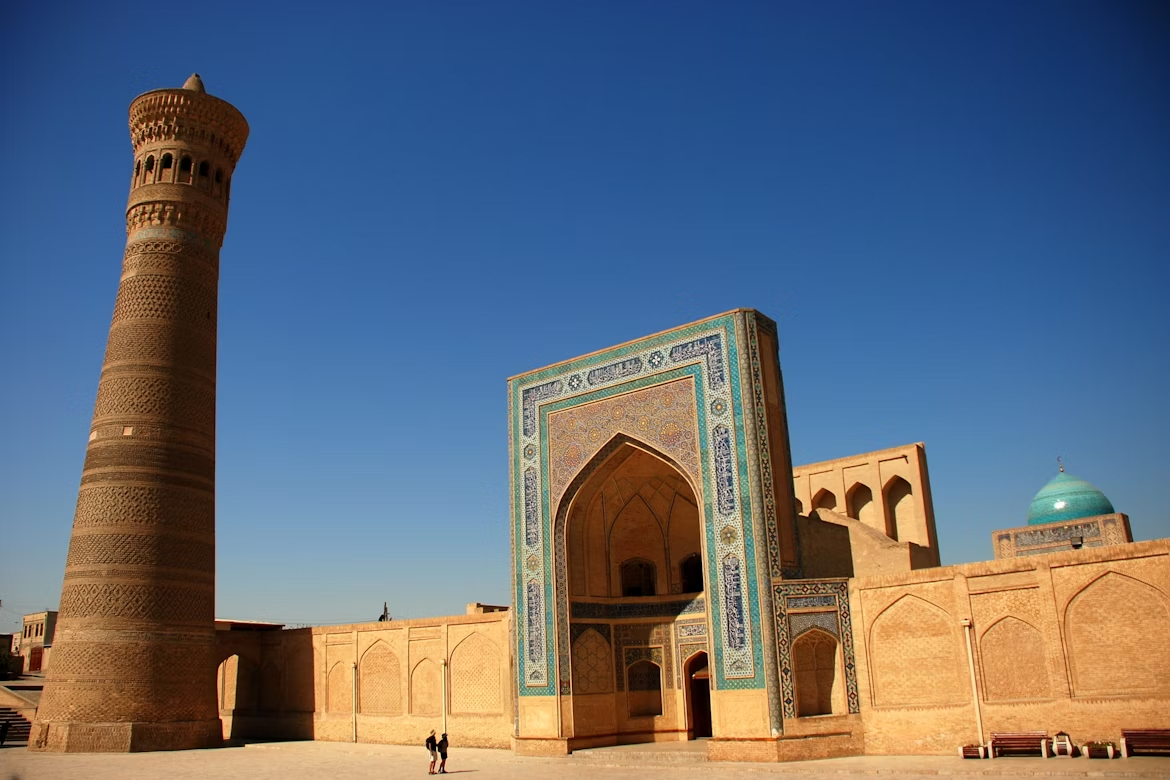
The Sacred Craft & The Upside‑Down Technique
There’s a scent that walks before the sun in Samarkand. Not the crispness of dawn or the smoke from early fires- but a deeper thing. Something warm, primal, alive. The scent of bread- not just baked, but born.
Tucked in a maze of alleys behind Shah-i-Zinda, where the tiles still remember Timur, there’s a family bakery with no nameboard. Just a soot-kissed doorway and a queue of locals with cotton bags, not phones. Step inside, and your eyes sting before your heart does. Because here, bread doesn’t lie flat. It climbs.
An old man- Ahmad Usta- kneels before a blazing tandoor set into the earth. His son balances the dough on a round cushion, stamps it with a wooden chekich, and with one sharp movement- slaps it upside-down onto the scorching inner wall of the clay oven. Gravity sighs. Steam hisses. The dough sticks like it’s made of vows.
This is no stage trick. No culinary gimmick for Instagram. It’s a technique passed from grandfathers to grandsons, done at dawn, repeated with reverence. This is the upside-down bread of Uzbekistan- sacred, silent, and fiercely alive.
Not a Trend. A Testament.
TikTok may have noticed it last year- 15 million views of a man in a skullcap slapping non onto an oven wall like a holy pact- but this isn’t a food trend. It’s a survival story.
Non (pronounced ‘nahn’) is not just bread. In Uzbekistan, it’s law. It cannot be placed upside-down on a table. It cannot be thrown away. It must not be cut with a knife- only broken by hand. It is the first thing to greet a guest and the last thing to leave the table. Even when a soldier leaves home, his mother sends him with a non, placed on the highest shelf, promising: “Until you return, this will wait.”
And it’s not baked in just any oven. These are tandoors- called “tonur” locally- sunken, sacred, and always seasoned with generations of smoke. The walls are made from a mix of clay, goat wool, salt and cottonseed oil- because science may explain heat distribution, but grandmothers insist it’s the wool that brings the soul.
The result? Crusty gold edges, a soft belly, and a distinct centre stamp that tells you not just where it came from, but who touched it last. Some stamps date back to dynasties. Others are handmade by blacksmiths from the baker’s own village.
The Quiet Power of the Craft
Meet any master baker in Samarkand or Bukhara and you’ll notice: they don’t talk much. There’s no showmanship, no artisan beard, no chalkboard menu. Only discipline. The dough is kneaded at 3 a.m., rested under muslin cloth, carried with forearms dusted in flour, and baked in silence. The pattern of movements- the slap, the stick, the rotation inside the tandoor- is almost choreographic. You don’t learn it from YouTube. You inherit it.
Ahmad Usta, for instance, isn’t on TripAdvisor. He doesn’t do classes. But if he trusts you- if you come not with a camera but with quiet- he might let you try. Might. There’s only one rule: don’t drop the dough. That’s not a mess. That’s disrespect.
Because here, in Uzbekistan, bread is not a dish. It’s a blessing.
Did You Know?
- Samarkand non can last for over 30 days without spoiling. Caravans on the Silk Road carried stacks of it across deserts, treating it like edible currency.
- The upside-down technique allows the bread to puff and caramelise without ever being flipped- developing two contrasting textures: charred bottom, pillowy top.
- In some rural bakeries, women place a fresh non on the pillow of a newborn, as a symbol of health and abundance.
- The centre stamp is not decorative- it allows the heat to escape from the middle, keeping the bread flat and preventing it from ballooning.
- In the Soviet era, the collectivisation of bakeries nearly wiped out this tradition. It is only in the last two decades, post-independence, that family ovens have returned- and with them, the technique.
Why This Isn’t Just Bread
When we say “non” in Uzbekistan, we’re not speaking of carbs. We’re speaking of community. Of ritual. Of rhythm. The kind of rhythm that calls a grandmother to rise before light. That sets firewood crackling while the rest of the world still sleeps. That teaches a boy not just to bake, but to wait.
And that’s what you’ll find in Samarkand’s hidden bakery quarter- no neon signs, no QR codes. Just warmth. In ovens, in hands, in history.
The Physics, Technique & Upside‑Down Baking
Why fire, dough and tradition dance vertically - and how that legacy shapes Uzbek identity
Gravity as Ally, Not Enemy
When you see dough slapped onto the searing inner wall of a tonur, it’s tempting to think it’s just showmanship. The sizzle, the upside-down adhesion, the defiance of physics - it’s made for Instagram, surely. But in Samarkand and Bukhara, where bakeries still rise before the azan, the technique predates Wi-Fi by a millennium.
These underground tandoors, called tonur, are heat-holding marvels lined with goat wool, gum and salt - all naturally insulating materials passed down through generations. The dough sticks because it’s designed to. At 320°C, the clay walls create an environment where the outer surface crisps in seconds, while steam builds inside, lifting the dough without flipping or poking. It detaches on its own - light, firm, and fully cooked.
The upside-down method isn’t just efficient - it’s sacred. In Uzbek culture, the bread (non) is considered so holy that if it falls, it must be kissed. You don’t throw bread. You don’t even cut it with a knife. You tear it by hand - always gently.
A Craft of Rhythm, Not Recipes
There’s no written recipe for authentic non. The ingredients - wheat flour, salt, water, sometimes grape-seed oil - are deceptively simple. The magic lies in timing and intuition. Bakers, often barefoot, watch for how bubbles form on the side of the dough facing the hearth. They know, by eye and fingertip, whether the dough needs another five minutes to rest or whether it’s ready for the slap.
That slap, onto a velvet-lined cushion called a chilla, and then against the wall of the tonur, is executed in one swift arc. And no, it doesn’t fall - unless the baker’s touch is off. Which it isn’t.
The tonur cooks the bread in just under a minute. No turning. No checking. It simply bakes in place, upside down, until it’s pulled out with long, handcrafted iron tongs - often forged by local blacksmiths, specially measured to each oven.
In traditional households, it’s the matriarch who oversees the bake. Many still use vinegar-based starters preserved from pre-Soviet times, a living culture older than many Uzbek apartment blocks.
The Stamps That Speak
One of the most fascinating parts of the process is the use of chekich - wooden or metal stamps pressed into the dough’s surface before baking. Think of it as an edible fingerprint. The patterns are not ornamental fluff; they release air and prevent the centre from puffing unevenly. Each chekich is unique - some bearing symbols, others the initials of a family or village, even the oven’s founding year.
In Bukhara, chekich stamps sometimes include Arabic inscriptions, while Tashkent families stamp Cyrillic initials - reflecting centuries of overlapped empires. A single stamp can tell you where the bread came from, who baked it, and how long that technique’s been guarded.
Soviet-Era Silence - And the Fire’s Return
There was a time, not long ago, when this craft nearly vanished. During the Soviet era, industrialised baking and collectivisation nearly extinguished the tonur. Public bakeries replaced family ones, and dough was leavened with yeast imported from Moscow, stripping the bread of its signature texture and life span. The bread became functional. Shelf-stable. Tasteless.
Post‑independence, however, sparked a revival. In Samarkand, artisans like Azizbek rebuilt tonurs from memory. Some mixed their clay with camel hair and pine ash - recalling how their grandfathers insulated heat in desert winters. Families began passing down sourdough starters again, treating them like heirlooms. What the Soviets standardised, the Uzbeks have reclaimed - crack by crack, flame by flame.
Stories in Every Crust
Ask anyone in a traditional Uzbek bakery why they bake upside down and you won’t get a physics lesson. You’ll get stories. Of grandparents who baked during Ramadan by moonlight. Of tongs gifted at weddings. Of secret stamp designs revived from ancient scrolls.
One woman in Bukhara still uses her great-grandmother’s clay tonur, patched over the years with ceramic shards from family tea sets - because “broken memories still hold heat.”
In this way, Uzbek bread isn’t just food. It’s language, memory, science, and soul - cooked vertically.
Beyond Samarkand: The Bread Trail
“This recipe doesn’t need salt. It needs time.”
You’ll hear that often in Uzbek baker circles - usually with one eyebrow raised and both hands in dough. Because if Samarkand is the spiritual centre of non (Uzbek bread), then its true archive lies in the calloused palms of bakers whose family names never made it to signboards. In alleys with no GPS location, generations have risen - quite literally - before dawn, not just to bake, but to preserve.
Take Ahmad-aka’s family, for instance. His grandson now runs the famous tour that winds through Samarkand’s backstreets - part bread class, part oral history. But rewind a few decades, and this wasn’t a performance. It was livelihood. Ahmad himself learned the sacred symmetry of non from his grandfather, who baked during the Soviet era when flour was rationed and gas lines curled like snakes outside ration shops. Back then, baking bread was an act of resistance and survival, not craft.
A Trail of Crumbs – From Samarkand to Bukhara
Samarkand may be the face, but Bukhara is the soul. Unlike the famed round, stamped loaves of Samarkand, Bukhara’s non is thinner, crispier, and glazed with syrup-thinned egg for a mirrored sheen. It’s less about display and more about delicacy. If Samarkand's bread is a manifesto, Bukhara’s is a whispered poem.
In old Bukharan quarters, women still gather in courtyards to roll dough under apricot trees, chatting in Tajik-inflected Uzbek. You won’t find these women on travel websites - and they’re not interested in your camera. But if you’re lucky enough to be invited in, you’ll notice the dough is folded with stories: about weddings, war-time scarcity, or that one neighbour who adds too much yeast.
Local baker Islomjon recounts how, during the Soviet clampdown on religion, Friday prayers were banned - but neighbours would smuggle notes with Quranic verses into loaves to pass through Soviet checkpoints. Sacred text, quite literally baked into bread. Is it true? Who knows. But the story has risen over time, like the dough it speaks of - proof enough for most.
Tashkent’s Modern Take
In the capital, you’ll find the new generation of bread-artisans. Trained abroad, often armed with Instagram handles and fermentation science, they’re reviving regional non styles with a modern twist. You’ll see sourdough infused with black cumin, or loaves stamped with contemporary calligraphy motifs. Still, every one of them bows (sometimes literally) to the Samarkand masters. They speak of them like monks talk about forest sages.
At Feruzjon’s workshop in Tashkent, guests can now participate in what he calls “memory baking.” Each visitor is given a station, a tandoor, and a story - a real one, often recorded from elders. The task is simple: bake a loaf inspired by that story. Results are chaotic, but the point is clear - non is a vessel, not just for ingredients, but for intergenerational memory.
A Word on Gender
Historically, bread in Uzbekistan has been a male-dominated craft, at least in commercial terms. But many of the quiet matriarchs in rural kitchens hold techniques that date back further than any bakery tour. Some historians argue that the earliest tandoor loaves were domestic, made by women in nomadic tents - and commercialised only later. Today, there’s a quiet but fierce resurgence: women-run bakeries in Ferghana, bread cooperatives in Karakalpakstan, mother-daughter tandyr circles in Andijan.
If you’re travelling with Unhotel, we’ll likely introduce you to one of them - not because it's fashionable, but because it’s truer to the roots.
Not Just a Side
In Uzbekistan, non is never an afterthought. It’s placed at the head of the table. It’s kissed when dropped. And in death rituals, a final loaf is broken as remembrance. Every region, every family, every oven adds its own dialect to this culinary language. And every traveller who listens - truly listens - ends up carrying a loaf-shaped memory back home.
The Master’s Workshop: Where Bread Meets Memory
“You’ll forget the recipe. But you’ll remember the smell.”
That’s what Kamola, the soft-spoken matriarch of a fifth-generation Samarkand bakery, tells her guests as they kneel beside the tandyr oven. No white aprons. No laminated instruction sheets. Just fire, flour, and the occasional chuckle when someone burns their fingertips too close to the inner clay wall.
This isn’t a cooking class. This is a remembering class.
And for luxury travellers who think they’ve seen it all – from Tuscan truffle hunts to Kyoto tea ceremonies – this is Uzbekistan’s soulful counterpoint. Welcome to the Master’s Workshop.
Step Inside the Tandyr
In a humble courtyard tucked behind a crumbling madrasa wall, the air carries a fragrance that borders on spiritual – scorched wheat, singed sesame, warm clay. The tandyr oven yawns open like a belly of fire. It’s hand-built, moon-bellied, and patched with memories. You’re handed a disc of dough, rolled earlier by the family’s youngest daughter, and a little stamp called a chekich – a wooden tool that looks deceptively simple, until you try using it without tearing the surface.
Every visitor who enters this space is briefly apprenticed into a ritual that’s older than most countries. You’ll learn to flatten dough using the heel of your palm. To gently prick the centre so it doesn’t puff too much. To slap it against the oven wall – with just enough force to stick, but not so much that it folds in shame.
And just when you start to think you’ve got it, someone will whisper: "Don't forget to bless it."
Because the real ingredient here isn’t technique. It’s intention.
What Luxury Really Looks Like
If your idea of luxury is crystal flutes and a seven-course tasting menu, you’ll need to recalibrate. Here, luxury is time. Stillness. The way a grandmother presses her fingers into the edge of a loaf to shape a memory of her own wedding day. Or the moment an old man recites verses from a 12th-century poem while kneading dough.
Unhotel’s bread immersion experiences don’t happen in showroom kitchens. They happen in working homes – curated with reverence, not spectacle. Some of these bakers only take two visitors a week. You’ll share a pot of green tea. Maybe pass around a bowl of homemade apricot jam. Sometimes, you’ll leave with more than just a loaf – like a hand-carved chekich, or a story you’ll spend the next year trying to retell over dinner.
What You’ll Feel, Not Just Taste
There are no “Instagram corners” here. The beauty is baked in. You’ll feel it when the dough first touches the tandyr wall with a soft thwump. When the outer layer chars into bronze lace, while the centre swells, pillowy and alive. You’ll smell sesame and black cumin singing in the heat. You’ll hear nothing but breath, fire, and maybe the faintest hum of a lullaby from the neighbouring courtyard.
And then – the moment of truth. A flat wooden paddle scoops your loaf out. It’s hot, uneven, and perfect. You tear it. No knives. No hesitation. The steam carries with it the ghost of a thousand breakfasts past. You taste – and for once, you’re not thinking of sourdough starters or gluten content. You’re thinking of how quiet your mind just became.
What to Expect (and What Not To)
Expect simplicity. Clay floors. Aluminium kettles. A rooster announcing your arrival.
Don’t expect perfect English. But do expect perfect hospitality. Someone will always be there to translate – either a guide, a granddaughter, or sometimes just a smile.
Workshops usually last 2–3 hours. They’re scheduled to coincide with actual baking cycles – early mornings or late afternoons. Some end with a meal. Others with tea and tales. The price typically ranges between ₹6,000 and ₹9,000 per person, depending on whether it’s a solo session or a family one. Unhotel arranges these with bakers who are generous with their skill but cautious with their privacy – which is why you won’t find them on booking sites.
But if you come with respect, curiosity, and time – the reward is rare: not just a new skill, but an old way of feeling.
Cultural Context: Bread as Identity, Ritual & Revival
Bread as the Heartbeat of Uzbek Life
In Uzbekistan, non isn’t merely flatbread. It’s life - baked, broken, and shared. It begins at home and ends at the table of a stranger. New mothers are gifted non upon birth; funerals end with a last loaf; guests receive it with a kiss on the cheek, never on the crust. Uzbek proverb: “If you haven’t broken bread, you haven’t met anew.” This is the fabric of social currency-woven in dough.
Across the Silk Road, traders carried stacks of non as edible travel cash. It wasn’t just sustenance-it was survival. Local lore claims one tonur batch could serve caravans for weeks. Bread that stayed fresh in the desert was wealth.
Sufi Roots & Spiritual Texture
In many Uzbek towns, bread intertwines with spirituality. Sufi traditions often center around communal loaf-making halaqalari-circles where devotees share stories, prayers, and hot non fresh from tonur. Bread here is seen as a divine offering-each pull of dough a gesture of humility. After prayers, the same loaf is served to the poor: a ritual of gratitude.
Some mosques still bless dough before dawn Andaftar (meal of sacrifice) during Ramadan. Grandmothers may whisper prayers while pinch-kneading; the same prayer repeated for thousands of nights, word for welcoming bread as God’s blessing. In this way, non is more than food-it's spiritual connection.
The Revival After Silence
During Soviet times, central ovens replaced home tonurs. The bread turned sterile-mass-produced white slabs lacking soul. But following independence in 1991, locals rekindled ancestral ovens. Government-backed programs provided clay and training. Small grants helped families restore tonur and preserve starters. The goal? To reclaim identity through dough.
In 2021, the Samarkand non was designated a National Brand of Uzbekistan, a seal of culinary pride backed by media and the tourism board (uza.uz). Local festivals began to feature baking contests. Artisans reformed guild-like associations, ensuring that tonur traditions wouldn’t vanish again.
Asrlar Sadosi: A Festival That Lets Ovens Sing
Enter Asrlar Sadosi, Uzbekistan’s premier festival of living heritage, held annually in Bukhara and recast in Samarkand in recent years. Asrlar Sadosi brings artisans, musicians, and chefs to public squares-not for show, but for storytelling. Tonur ovens are fired along ancient caravan serai lanes; dough is stamped, baked, and sold as fresh as belief. Visitors taste breads from villages, compare stamps, and learn stamping patterns tied to specific yurt clans.
Bread-making isn’t sidelined here-it’s star. Bookmakers compete for the crispest bottom, the lightest centre, the richest aroma. Experts from UNESCO have attended, ensuring techniques align with Intangible Cultural Heritage norms and community-based preservation (wikipedia.org). That ancient stamp on your loaf becomes more than a pattern-it’s living culture.
Bread as Harvest, Ceremony & Ceremony’s Companion
In wedding ceremonies, an elder places non on the bride’s head as a blessing. In harvest festivals, freshly milled wheat is ground into dough on a pilav table. Each recipe changes-some villages sweeten their non with rosewater; others add melted butter and nigella for a darker glow.
Even during Eid, you won’t just receive sweets. Hosts present non, sometimes stitched with dried fruit or dressed in saffron - because every sugar-laced bite must begin with the original anchor: bread. It’s food diplomacy, woven in flour and heart.
Why This Matters for Travelers
For travellers seeking more than visuals, Uzbek bread represents connection. When Unhotel arranges your journey, we offer you:
- Private invitations to tonur rituals during Asrlar Sadosi behind curtain zones
- Visits to family bakeries where makers still use pre-Soviet starters and stamps
- Artisan handshake sessions, where a baker shares the stamped pattern from his village
- Hi-end photography moments (not selfies)-loaves displayed under medieval arches at dawn
By experiencing the unfinished ceremony of bread-from dough to tear-you’re not just seeing heritage; you're tasting memory.
Why Stranger Hospitality Feels So Real
In Uzbekistan, sharing bread is foundational. Many hosts resent empty packages of bread left behind at the end of your stay-it’s a signal you left without parting properly. That’s how deeply bread features in etiquette.
Some Uzbek bakeries offer travelers an ultimatum: “Break bread with us at tea, or keep your ticket.” And most of us stay.
Because bread here isn’t just carbohydrate. It’s warmth. Culture. Continuation.
The Luxury Traveler’s Experience
Bread You Can Book
Let’s be honest - you don’t fly 3,000 km to eat carbs. Unless those carbs are baked into the walls of a nation’s soul.
And in Uzbekistan, they are. But here’s the difference - you’re not queuing at some TikTok-famous bakery, elbowing past teenagers with phone gimbals. You’re pulling up a handcrafted wooden stool in the back alley of a 3rd-generation Samarkand oven, where the only WiFi is the scent of rising yeast and cumin.
When to Go
Spring (April–May) and early autumn (September–October) are golden windows. The air is cool enough for long walks through Silk Road cities, but warm enough that the tandoor heat still hugs you like an old auntie who’s missed you. These are also prime times for festivals like Asrlar Sadosi, where regional bread masters gather for public bake-offs that feel less like a contest and more like spiritual theatre.
Where to Stay
Base yourself near the bread action. DiliMah Premium in Samarkand puts you a short walk from both historic Registan and backstreet bakeries. In Bukhara, Amelia Boutique Hotel pairs old-world charm with fresh morning non served in mosaic courtyards. Want something extra? Unhotel travellers can opt for private villa stays curated near artisanal hubs - where bakers will actually come to you for a fireside demo under the stars.
Expect premium stays to range from ₹12,000 to ₹25,000 per night, and private bread experiences to cost ₹4,000–₹7,000 per person - including translation, cultural briefing, and enough carbs to cancel your dinner plans.
How to Book
Here’s the catch: you won’t find this on Booking.com. These aren’t tours. They’re introductions - arranged through Unhotel’s network of cultural fixers, linguists, and artisans. You don’t "schedule" a bread lesson here. You’re invited to one.
Call to Crumb-Action
They say you don’t remember trips; you remember moments.
Like the crinkle of an old baker’s eye as he stamps dough with his family seal. The hush of a room watching non stick to the roof of a tandoor in perfect silence. The first tear of a saffron-salted crust, still too hot to hold.
This isn’t just bread. It’s witness. It’s ceremony. It’s time slowed down enough to taste.
.avif)
.avif)
Subscribe to stay inspired.
Stories, ideas, and slow journeys - from hidden villages to distant valleys, straight to your inbox.
.avif)