

Clay, Thread, Flame
Uzbek craft lives in daily use rather than display handwoven textiles, carved wood, and glazed ceramics shaped by rhythm, repetition, and lineage, revealing a culture where making is inseparable from living.

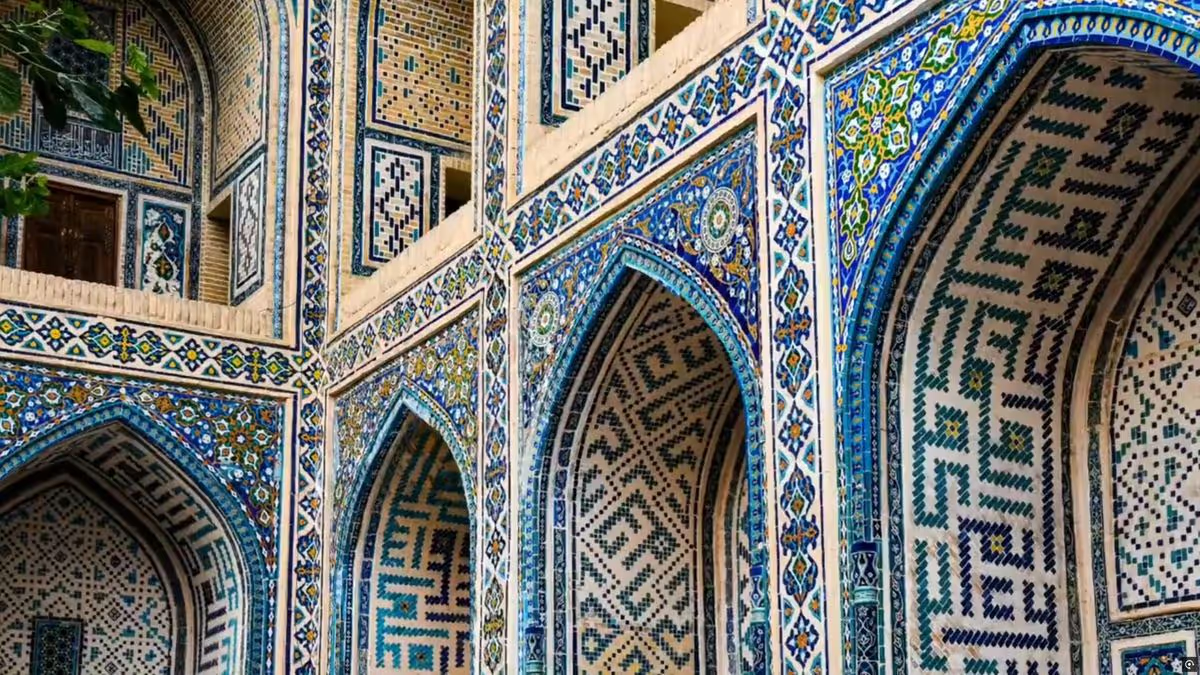
Uzbekistan’s craft traditions, and the apprenticeships that preserved them
Uzbekistan’s craft economy didn’t survive the twentieth century by accident.
Across Central Asia, Soviet industrialisation flattened local production into standardised output. And yet, in certain homes and back rooms, the old methods continued. Women stitched suzani (embroidered textiles) quietly. Potters kept wood-fired kilns alive even when gas kilns were mandated. Wood carvers taught children patterns that were dismissed as economically obsolete.
This isn’t a catalogue of crafts. It’s a look at how knowledge survives when it is passed hand to hand, over years of observation, repetition, and correction.
Craft as cultural resistance.
Suzani: when embroidery encoded economics
Suzani isn’t just decoration. Traditionally, it was dowry infrastructure.
In many families, a bride’s suzani work began when she was born. Wall hangings, bedcovers, prayer mats. The stitching continued for years, often involving mothers, aunts, and grandmothers.
By the time of the wedding, the bride might have ten to fifteen major pieces.
This wasn’t sentimental craft. It was portable wealth. Silk thread was expensive. Complex patterns signalled skill. Certain motifs hinted at regional identity and social networks. In hard times, textiles could be sold. In good times, they were proof of status.
Soviet collectivisation tried to eliminate this as bourgeois excess. Many women continued anyway. Informal embroidery circles became a quiet economy, and a quiet act of refusal.
Today, you can still meet makers whose work carries that lineage.
In Tashkent, one of the country’s most recognised suzani artists is Madina Kasimbaeva, whose pieces appear in museum collections internationally. What matters, though, is not the fame. It’s the continuity of technique.
If you spend unhurried time in a master workshop, you start to see what the eye misses at first glance.
Patterns are often constructed from memory, not traced templates. Stitch types create dimensional effects. Colour placement follows internal logic that feels intuitive until someone explains the mathematics of rhythm.
In Urgut, the Thursday market brings embroiderers from surrounding villages to sell directly. The range is wide. Machine embroidery sits beside hand-stitched pieces that take months.
Distinguishing them isn’t about being clever. It’s about knowing what to examine: thread tension, backing construction, the small irregularities that reveal a human hand.
Material literacy you can’t learn from photographs.
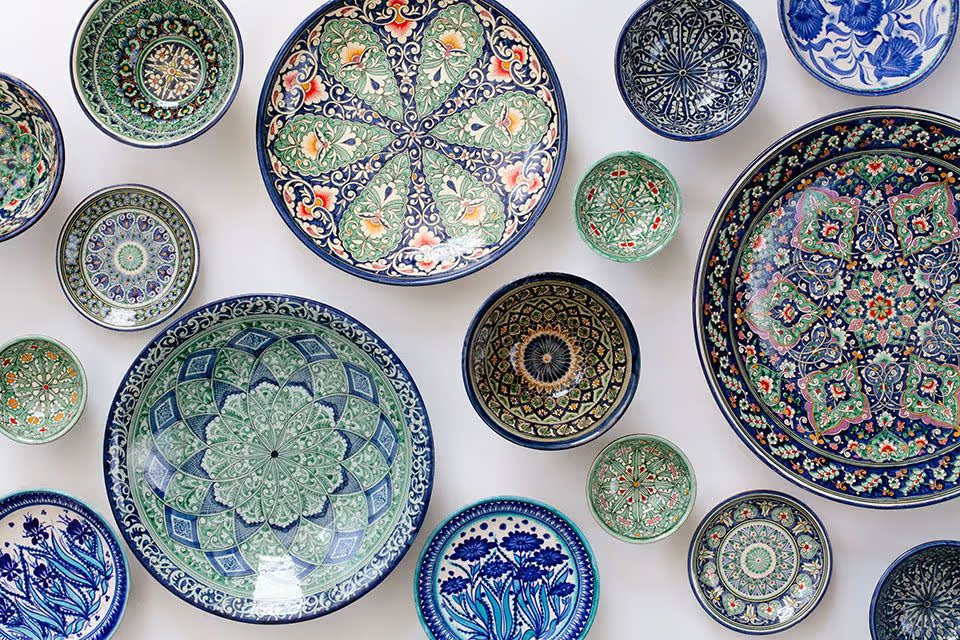
Rishtan ceramics: the chemistry of blue
Rishtan pottery is recognisable by colour alone.
That blue-green glaze, distinctive across Central Asia, comes from ‘ishkor’ (a plant-ash glaze) mixed with copper oxide, applied to pottery made from Rishtan’s red clay.
The craft stayed rooted because the material did.
Rishtan clay has mineral properties that interact with ‘ishkor’ in ways other clays do not. Attempts to replicate the tone elsewhere have often fallen short. The result is a tradition that is both aesthetic and geological.
In a master potter’s studio, you can still see the full sequence:
- Clay preparation
- Wheel throwing
- First firing
- Glaze application
- Final firing, often in wood-burning kilns
The kilns themselves feel like architecture. Multi-chamber brick structures. Long firings. Temperature control judged by flame colour, sound, and experience.
You might watch pottery being thrown on kick wheels at the same human pace they have always moved. You might see ‘ishkor’ glaze mixed by eye, adjusted for seasonal variation in ash composition.
In Rishtan, there is also a Japanese-supported ceramics school where Uzbek methods are being documented and taught alongside Japanese approaches to glazing and firing. The exchange is revealing. Both traditions value apprenticeship and material sensitivity, but their aesthetic philosophies diverge in quiet, instructive ways.
Wood carving: seven generations in Kokand
In Kokand, the Haidarov family has been carving wood for seven generations.
Their lineage runs through empires and ideologies. A great-grandfather who produced decorative work in the early Soviet period. A grandfather who carved doors for palaces. A father who trained under restrictions that treated many traditional motifs as religious imagery.
The workshop itself, often in a restored nineteenth-century house, becomes part of the lesson. Doors, columns, and ceiling panels show relief carving, geometric inlay, and arabesque patterns that take months.
What you learn here is that carving is not only artistry. It is planning.
Patterns are mathematical precision disguised as organic flow. Wood choice changes what is possible. Walnut allows fine detail. Mulberry holds structural elements. Motifs that were prohibited were sometimes preserved through subtle modifications, enough to pass inspection, enough to keep the lineage alive.
Some families also keep small archives: tools used by previous generations, pattern books never published, correspondence with cultural authorities.
Craft history as lived experience.
.avif)
Metalwork in Bukhara: when tools became status
Bukhara’s metalwork tradition began with necessity.
A city needs knives, scissors, locks, keys. Over time, utilitarian production evolved into decorative art. Scissors became so elaborately worked they stopped being tools and became status symbols.
The technique remains direct.
Steel is forged and shaped by hand, then inlaid with brass or silver in geometric patterns. A single ornamental piece can take days.
The inlay process is the part that stays with you. Wire is hammered into grooves carved into steel. The metal expands slightly and locks into place without adhesive. Done well, it is permanent. Done poorly, it fails.
Many workshops still make functional tools too, including kitchen knives prized for their edge geometry. The ornamental work often subsidises the practical work. Both depend on the same mastery.
The Applied Arts Museum: context before experience
Tashkent’s Applied Arts Museum sits inside a palace built for Tsarist diplomat Alexander Polovtsev, who invited Central Asian master craftsmen to decorate his residence.
The building itself is a map of the crafts: carved wood ceilings, ceramic tilework, embroidered textiles, metal inlay.
If you visit early in a trip, it gives you context that makes workshop time more legible. You begin to recognise design principles across centuries. You see that what looks like revival is often continuity.
Not reconstruction. Continuous practice.
.avif)
Why apprenticeship still matters
Uzbekistan’s craft traditions survived because they couldn’t be learned from books.
Suzani embroidery requires understanding how thread tension creates dimensional effects, knowledge acquired through years of corrected mistakes. Ceramic glazing depends on reading kiln temperatures by sound and colour. Wood carving demands spatial visualisation that develops only through repetition under a master’s eye.
The Soviet system tried to replace apprenticeship with technical schools and standardised methods. It worked for industrial output. It failed for crafts where judgment and variation are essential.
So families continued privately.
What you see in workshops today is not heritage theatre. It is active production. Apprentices observe, attempt, get corrected, repeat, and repeat again until capability becomes instinct.
You leave with a simple understanding.
Certain skills cannot be preserved through museums alone. They live in relationships, in obligation, and in the slow transfer of knowledge from one pair of hands to another.
For customised craft and cultural itineraries in Uzbekistan:
manish@unhotel.in
.avif)
.avif)
Subscribe to stay inspired.
Stories, ideas, and slow journeys - from hidden villages to distant valleys, straight to your inbox.
.avif)